
Old Dog Digital

Digital Marketing Consultants in South Florida.

Tag: Social Media

Websites that enable users to create and share content, and participate in social networking.

  • Let them find you!

    Let them find you!

    Let’s say that you have the greatest business card ever. It has a beautiful design, a perfect font face, an engaging and catchy slogan, and it’s printed on a kind of paper that not only looks great but also feels wonderful to the touch. How will anybody know about this if you don’t share it?

    The same thing happens with your social media profiles and your website. You might have the perfect website and the greatest social media content ever, but you need to let people know that it exists and where to find it for it to work.

    That’s what advertising does for you. It makes it easy for your audience to find your website and your content. It also tells people how to contact you and what products or services they can buy from you.

    In a previous post, we had already said that digital marketing is a lot cheaper than traditional marketing, but it still has a cost. The best thing is that there is no minimum required, so you decide how much you want to spend on it. Obviously, the more you invest, the better the results you will get.

    What makes a digital ad different from a boosted post is that digital campaigns, which are made of ads, can have many different business objectives, while boosting a post can only be used to increase the number of people that sees it and/or to help it get more likes and comments.

    Brands invest a lot of money in advertising, just to let people know what products or services you could buy from them. Photo by Jose Francisco Fernandez Saura on Pexels.com

    Imagine that you’re just starting a new business, and as we said in the first paragraph, you already have a great website and social media content. Now, you need to tell everybody that you exist, what is it that you do, and where they can find you. But how?

    Facebook and Instagram will recommend you boost your posts, and doing that would be great, but that doesn’t help you increase the traffic to your website, where clients would learn more about you, subscribe to your new podcast, schedule an appointment, or whichever the action you want them to do.

    Google can help you with that. A digital campaign on that platform would show your ad to people that would already be looking for somebody that does the same thing that you do, and that is what you want, so Google is one option.

    Another option is to advertise on Facebook and Instagram, or whichever social media platform you choose, instead of just boosting your posts. You could start a campaign and that would do an excellent job, given that you invest a reasonable amount in it.

    Or even better, you could do both things at the same time and start a campaign on Google and social media. That would allow you to try different formats, content and even do some experimentation, to see what works better.

    Remember that there are no magic recipes, and whatever works for one brand might not do the same for another. This would make the last option the best alternative, so don’t be afraid to try new things, start small and increase the investment once you’ve found what works for you.

    Digital ads and boosted posts serve different purposes. Depending on what your objectives are and your budget, you could use one, the other, or both options to get the results you want.


  • Give it a boost!

    Give it a boost!

    The term “organic reach” represents the number of people that sees your content on social media without you having to pay for it. A few years ago, you could have some pretty decent interaction and reach numbers this way, but not anymore.

    Social media platforms have made sure that the organic reach of your content gets seriously limited because they want you to pay. They want you to invest in the promotion of your content because that’s their business, that’s the way they make money.

    Surely, you’ve already heard something about the algorithms and their negative effect on the reach of your content. Maybe you’ve heard someone blaming the algorithms for their posts’ low interaction and engagement.

    Algorithms are just mathematical expressions that work as a set of instructions when performing a calculation. For example, the algorithm that determines the number of people that sees your content on their news feed for free versus the number of people that sees that very same post when you pay to boost it.

    Paid reach is always greater than organic reach, and it helps you grow your audience in a shorter time. It would take you years to get your organic reach to the levels that paid reach does in just a few weeks. So definitely paid reach and boosted content should be a part of your strategy.

    Just like a ladder helps you reach higher spots, boosting social media content will help you reach a wider audience. Photo by Pixabay on Pexels.com

    But what happens if you are working on a limited budget? Don’t worry. You don’t need to spend a lot, there is no minimum amount to invest. You can spend as little as a few dollars a month and get some results.

    Obviously, the more you invest the better your numbers will be, but even just a few dollars a month can make a difference for your brand, especially in the early stages of a campaign or when launching a new product.

    Promoting on social media will always be cheaper than doing it on traditional media, like television, radio, or newspapers, and the results you get are a lot better too, so don’t hesitate to invest your money in boosting your content.

    It is a shame to see a lot of quality content go to waste because of the extremely low organic reach it gets. Many brands make the mistake of increasing the frequency of their posts, instead of increasing their reach by boosting them.

    One important clarification that has to be made is that boosting your content will only get you a greater reach for your content, and more engagement too, but it is not the same as Paid Ads, that’s another story and we will talk about it later

  • The World Cup has started, be careful

    The World Cup has started, be careful

    Today, the FIFA World Cup started in Qatar. Many brands see this as an opportunity to promote themselves by talking about this, supporting their home teams, orusing the same hashtags.

    That can be a great idea as long as you know what you’re talking about, but if you don’t know anything about soccer, it’s better to stay out of the discussion, because it could work against you.

    It is generally a great idea to stay away from topics that have nothing to do with you as a brand, be it politics, sports, or whatever subject comes to mind. If your brand is not related to sports, why would you say something about them?

    Supporting your home team is one of the pretty safe things you can do, but be careful and do not engage in a discussion with the opposite team. If you do, keep it polite, keep it brief, and keep it about the sport.

    If you’ve spent some time doing marketing stuff, you surely have noticed that you should never engage in a discussion about politics, unless you are a politician and/or fully understand every aspect of the topic that’s being discussed.

    The same thing happens with sports. Especially soccer, which is some kind of religion in some countries like Brazil or Argentina, or even Mexico. So, if you are not a soccer expert, stay away from it.

    You don’t want to be seen as an opportunistic brand or as a fake fan. That’s a label that’s going to take a lot of effort to remove once you’ve earned it. You’d think it’s harmless, but it’s not.

    Sportswear brands are generally very careful with their content. They have to make sure they are not sending the wrong message. Photo by EVG Kowalievska on Pexels.com

    Sportswear brands are very careful with this kind of thing. They hire experts to handle their content, so they don’t say anything inappropriate or anything stupid. One post can cause a lot of damage to your brand.

    Every time you post something, you should consider every aspect of it. Are you saying something that could be misinterpreted in some way? What is it saying about your brand?

    Remember, you should only talk about things that you want to be associated with. When someone thinks about your brand, do you want them to think about sports? About soccer?

    If the answer is no, then don’t even think about using the World Cup’s hashtags or saying something about it in your content. Soccer fans are very passionate, and even using the wrong terms can be very costly reputation-wise.

    You don’t need to be a part of every trend. Your content doesn’t need to include every hashtag. Pick only the ones that say the right things about your company, above all if it is about soccer and Qatar.

  • Tools for everything

    Tools for everything

    Once you start generating your own content, you will probably find yourself looking for a website where you can get free images, design resources, video and image editing software, and other similar tasks.

    Every social media platform offers free tools that can help you with these, and some of them even do it automatically, but the resulting images look pretty much the same for everybody.

    If you want your images to look different and reflect your brand’s personality, one option is to pay for third-party tools, which can be expensive for some budgets, especially if you are a small business.

    Luckily, there are free tools for everything all over the internet, and most are really good at what they do. You just have to look for them and pick the one that works best for you.

    It’s a matter of personal taste and whether the tool does whatever you need. The great news is that you can try them all and pick one because they are all free or have a free tier of service.

    There are free tools for everything on the internet. Don’t be afraid to try new things. Photo by Tranmautritam on Pexels.com

    Unsplash and Pexels are two websites where you can get free images. It is always best to generate your pictures, but if you just need an image to go with a post, then you’re safe. Never use them on a campaign.

    Maybe you want to modify that free image to make sure your post doesn’t look the same as everybody else’s. You could try Canva or Adobe Express to find some templates that help you make a composition.

    If you need to take it a step further, you could use GIMP, a free open-source alternative to Photoshop. Maybe it lacks Adobe’s software most recent functionality, but it can do almost everything its paid cousin does.

    You need to have some computer skills to use this kind of software, so if you want to keep things simple, stay with the first two options or try something like Picmonkey or Stencil.

    Infogr.am lets you create infographics and maps that you can present to your audience. Piktochart is another popular tool that does the same thing and has a great free plan to start with.

    Landscape is a great tool for resizing images that you want to use on social media. What I like about it is that you don’t need to remember the exact size in pixels for each platform, this tool does that for you and it stays updated.

    Clipchamp is a free tool for editing video, in case you need something more than the native tools of Instagram, YouTube, or Vimeo. Adobe Express also has a free video editing tool with which you can start.

    Like we said at the beginning of this post, there are tools for everything, and all you have to do is look for them on the internet and pick one. Don’t be afraid to try new things.

    The worst thing that could happen is that you end up looking different than the rest of your competitors, and that is exactly what you want to do.

  • You don’t need to be everywhere

    You don’t need to be everywhere

    Facebook, Instagram, Twitter, TikTok, Snapchat, YouTube, and Pinterest are just a few of the many social media platforms that brands use to promote their products. But, should you have a profile in all of them?

    The short answer is no. You should only invest your time and money where your target audience spends their time. Different groups of people use different social media networks, so your choices depend on with whom you want to talk.

    For example, younger audiences use apps like Tiktok and Snapchat almost everyday, while most of the adult population tend to use Facebook and Instagram. They might use other apps, of course, but these are the ones that they use predominantly.

    Another example is Pinterest. Almost 80% of their regular users are adult women, so if your strategy is focused on this segment of the population, you should definitely consider this platform.

    Depending on the age group you wish to target, you have to choose the social media platform where you will invest time and money. Photo by Pixabay on Pexels.com

    Depending on the age group you wish to target, your choice of social networks will take place. Facebook is the default choice for a lot of brands, simply because of the millions of users it has.

    Another very important factor to consider is what you do. If you want to talk politics, Twitter is where you need to be. If you make movies and/or create video content, YouTube and Vimeo should be your focus.

    LinkedIn has always been job oriented, so if you want to position yourself as an expert in your area, you should consider posting more frequently to this network, or even better, starting your blog.

    As you can see, you don’t need to be everywhere. You don’t need to have a profile on every social network that exists, You need to do some research and find out where your target audience spends their time. That’s where you want to be.

  • The “perfect” Community Manager

    The “perfect” Community Manager

    Many companies are looking for the “perfect” community manager. They want someone who knows everything about every social media platform in existence, but also has great skills as a graphic designer, video editor, content generator, paid media manager, copyrighter, programmer, and speaks four languages.

    That’s like looking for an excellent Quarterback, who can play as a wide receiver, a linebacker, a tackle, and can also score a 50-yard field goal. And, of course, if they can coach themselves that’s a big plus.

    Nobody can do that. Nobody.

    You might find someone who can handle all of that quite ok, but they won’t be excellent at it, in the same way a drummer is not great at playing guitar, or a chemist is not great at applied physics.

    The drummer and the guitar player are both musicians, but they have specialized in different areas. The same thing applies to scientists: chemistry, physics, and biology are completely different things.

    There is no reason why a community manager should know anything about programming or graphic design. They might know a few things about it, but their area of expertise is another.

    Multitool Swiss Army Knife
    You can’t expect your community manager to be like a swiss army knife: a multitool that fixes everything. There are specialized tools for specific jobs. Photo courtesy of the Openverse.

    Community managers, SEO experts, traffickers, social media managers, content writers, and web designers are just a few of the professions in the digital marketing industry, and each one of them has a very specific role, and each one of them requires a different set of skills.

    I’ve heard many stories about a graphic designer who gets hired to build a website, create content for Facebook, edit videos for Instagram, manage Google ads campaigns, and a lot more. Obviously, the results are far from perfect.

    I’ve also heard a lot of complaints about them spending too much time on their phones or Facebook when asking somebody about the new community manager they hired. Of course, they do, that’s their job.

    Community managers are supposed to generate a conversation about your brand, and they do that on social media using a cellphone and/or a laptop. They’re not supposed to build websites or create your new logo. They manage your communities on social media.

    You need a team to handle your digital marketing, not just an individual. You will only get the results that you want if you understand what needs to be done and the function of each person.

    Your perfect Community Manager doesn’t exist. Stop looking for it and build your team of digital experts or, even better, hire one, because they will already have the experience that your marketing needs.

  • Watch your tone

    Watch your tone

    Sometimes we focus on the wrong things. We tend to look for the latest trends in social media, the best formats to use, the best time to post, and the latest graphic design tools, but we forget about what’s important.

    Let’s not forget that social media’s main purpose is to generate a guided conversation between our potential clients and us as a brand. It has to be guided because we want it to be about us, about what we do.

    As we said in a previous post, this dialog lets us promote not only our services and products but the values and principles we want to associate with our brand. But we have to make it happen.

    How do we do that? By defining the language, the tone, and the style that we plan to use in that conversation. We have to make a series of objective choices that will define all that. This is communication 101.

    Do we want to be perceived as approachable or unreachable? Serious or funny? Professional or casual? We have to take into consideration all the characteristics that define us as a brand.

    Why should people follow you and not your competition? What makes you different? You don’t want to be perceived as boring or as someone that doesn’t listen You want people to follow you, to talk to you, because you want to convince them.

    Formal or informal? The style of communication that you choose will affect the way people see you as a brand. Photo by Liza Summer on Pexels.com

    The easiest way to do this is to create a character. Don’t worry, this character won’t show up on your social media or anything like that. It’s just a tool that will help create content with a uniform tone, style, and language.

    This imaginary person, with their personality, will be who you’ll become while creating content. That way, it doesn’t matter who writes it, it will always have the same traits.

    If your target audience is lawyers, you have to speak like a lawyer. If you are talking about cars, learn all the terminology and expressions that car fanatics use. You don’t have to be a petrolhead to talk like one, but if you sound fake, you will lose your audience.

    Whatever you choose will affect everything you do later, like the kind of things that you will post about, the kind of images that you will use, and even the colors that you pick.

    So make a plan that considers every situation. Prepare a document with all of these choices, some frequently asked questions, and their respective answers – You don’t want to sound robotic, so have some variations ready.

    When you start posting, stick to your plan. Always keep the conversation on the positive side and never insult anybody. If you get negative comments, listen to them and try to help, but never delete them. Trolls are an exception, never waste your time on them.

    As you can see, you can easily forget about the basic, but most important, aspects of communication. Defining this will save you a lot of future headaches. Like they say: “it takes one thousand posts to build a brand, but only one to destroy it”.

  • There is no magic recipe

    There is no magic recipe

    A few weeks ago, I was talking to somebody who wanted me to give him the solution to all his problems with Social Media, just by looking at the ads manager data that he had on his computer screen. “What do you see then?”, he insisted.

    I explained to him that I had to take a closer look at the numbers and the content that he was posting, so I could tell him something significant that could help him generate more leads, which he had already explained that it was what he wanted.

    He looked at me and said that he didn’t want me to do that, he just needed me to give him a general formula that could help him. He wanted the magic recipe that would take him to the next level on Social Media.

    Of course, my answer was that there is no magic recipe and no secret formula. Every brand is different and every account needs different things. Some things might work wonders for one brand, but be the worst to ever happen for another.

    Analytics and statistics should be your main source of information when defining your social media strategy. Don’t be afraid to experiment but always measure everything. Photo by Lukas on Pexels.com

    Social Media and Digital Marketing have been around for some years now, but the science behind them is still developing. Just take into consideration all the changes that all social media platforms are still making to their policies and the new functions and formats they are adding.

    Whichever analytics tool you decide to use, should be your main source of information. All the adjustments that you make to your digital marketing strategy must be based on statistics. This doesn’t mean that you can’t experiment, of course you can, but always measure everything.

    There are no rules, so feel free to try new things. There are however some best practices and you should follow them. There’s a reason why they exist. They are general things, but very important and you can read about them here.

    For example, posts don’t need to be that long. A few characters and a great image are better. Video content is king, but try different formats, because you don’t want to bore your followers. Don’t post too frequently also. Think about what you would like to see as a follower and start from there.

    The only thing you can be sure of is something we have discussed already: listen to your audience. They will tell you what to post, when to post, how often, and everything you need to know.

  • Facebook profile vs Business Page

    Facebook profile vs Business Page

    Frequently, I hear people complain about bad experiences that they had with Facebook. Some of them are friends and people I know, who tried to use it and didn’t work out, that come to me looking for advice.

    One of the things I’ve noticed is that most of them were using their personal Facebook profile and not a Facebook Business Page. When I point that out to them, the answer is always very similar: A what? Isn’t it the same? What’s the difference?

    A Facebook Business Page is a kind of profile with all the tools you need to promote your business. Some of these tools help you create content more easily, others let you schedule your posts or manage your ads. There are a few things that pages can do and profiles can’t.

    I’m not going to list these tools, because you can find all the information and very detailed guides about them on Facebook, in case you wanted to learn more about them.

    What I can tell you is that these people, the ones that we were talking about in the first paragraph, have noticed a huge change once they made the switch to a business page.

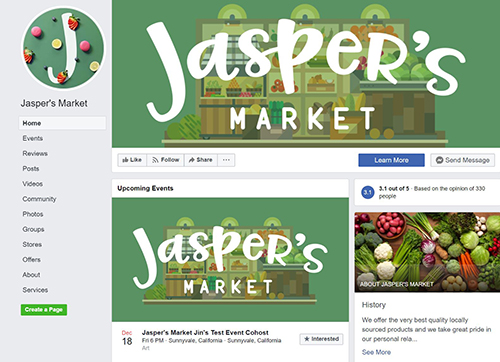
    A Facebook Business Page for a fictional brand.
    Facebook Business Pages have many tools that a personal profile doesn’t have. These tools help you create content, manage ads and keep track of what’s going on with your page. Photo by Facebook.

    In some cases, they have even decided that they didn’t need a website and that they were going to use their page as one. Yes, you can do that, but that doesn’t mean it’s the right choice for everyone. It depends on the kind of business you are running and your commercial objectives.

    One of the things I like the most about these pages is that they let you track every comment and interaction easily, which is one of the things you would be spending too much time on if you used a personal profile.

    Another thing I like is that you can create a team and assign a role for each member. This way, you can focus on your tasks while everybody else does their job. Personal profiles can’t do this. There’s no way.

    With a business page, you have control over literally every aspect of your content. You can plan your posts with all the anticipation that you need and you can schedule them, which makes managing a page a job a little less life-absorbing.

    The most important thing is that when you create a business page, you automatically create an Ads Manager account. This allows you to create campaigns to advertise and promote your brand.

    But even if you’re not using this feature for whatever reason, having a business page is preferable because they were designed with all the characteristics needed to promote your products or services on Facebook.

  • You need the whole package

    You need the whole package

    More than a few people have told me in different occasions that they want to start using “the internet” for their businesses, but that they don’t know what they need.

    Facebook, SEO, e-mail campaigns, websites, etc, it’s all the same for them. They don’t know the difference between one or the other and they don’t need to. They just know they need to do something about it and they should.

    That’s Digital Marketing and you need all of it if you want it to work properly and give you the results that you are looking for. You need a website that’s been SEO optimized, you need social media profiles with quality content, and you need an ads campaign. You need a complete strategy.

    It’s like an engine: you need all the parts of the machinery working at the same time for it to actually, well, work. So let’s take a quick look at each part of this complex thing called Digital Marketing.

    Engine showing all of its parts.
    You need all the parts of the engine running properly for it to work like it’s supposed to work. With Digital Marketing it’s the same. Photo by Tim Mossholder on Pexels.com

    Your website is your presence on the internet, It’s your home, and it contains all your contact information and a description of your services or products as a minimum. But you need to let everybody know that you have a website and it needs to be easily found, so it needs to be search engine optimized (Google is the most important search engine, but it’s not the only one).

    Facebook, Twitter, TikTok, and all the other Social Media platforms are a tool for building a deep connection with those interested in what you do or what you sell. Social Media, liked we discussed in a previous post, is where you build a community, a good reputation, and eventually a group of potential clients. You don’t need to have a profile in all of them, just the ones the people that might be interested in your products use.

    Ads let your message reach a wider audience, those who don’t follow you in social media and don’t know about your brand. They can also be useful for letting your existing audience know about your new products or services, or if you have a special offer for them.

    E-mail marketing is another important tool because it not only lets you send a message to your audience, it also lets you manage the relationship with them in a more personal way. Messaging services, like Whatsapp, are also excellent at doing this.

    This is not everything there is to know, that was never the intention of this post. We just want to let you know that you need all of it, the whole package: the website, the posts, the ads, the SEO. You will also need a clear objective. But that subject deserves its own post.